

Managing Misinformation During Public Safety Incidents

Managing misinformation during public safety incidents is one of the most challenging jobs you’ll face as a public information officer. In the first few minutes after a crisis starts, rumors and half-truths spread faster than official updates. And when people don’t get answers from you quickly, they fill the gaps themselves. Your credibility and your community’s trust depend on how you handle this.
Why does misinformation spread so fast?
People crave immediate updates during an emergency. Social media makes it easy for anyone to share what they hear without checking accuracy. A 2024 Pew Research Center survey found that 65% of Americans get at least some breaking news from social media, but only 30% trust it to be accurate. Source
False details can originate from well-meaning bystanders, disgruntled insiders, or malicious actors attempting to create panic. You can’t stop rumors from starting, but you can reduce their reach and impact.
Act fast or lose control
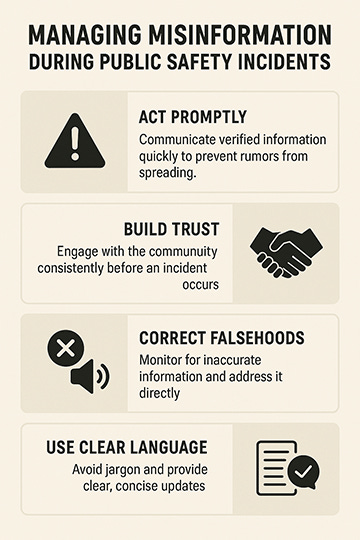
When a major incident happens, you don’t have time to “gather every detail.” You need to release verified information as soon as possible, even if it’s limited. The phrase “We’re aware of the situation and will update you as soon as we confirm details” does more than silence speculation — it buys you time while showing you’re working.
Delaying statements in the hope of perfect accuracy only creates space for misinformation. The public won’t wait for you. They’ll find other sources, and those often aren’t reliable.
Build trust before the crisis
The day of the incident is not the time to try to build trust. You earn it through consistent and transparent communication, long before any significant event. If you have a strong track record of sharing timely, accurate updates, people will wait for your official word.
Deputy Chief Communications Officer Jennifer Snyder of the Boston Police Department said in 2024, “Our biggest asset in a crisis is the trust we built beforehand. If the public doesn’t believe us on a regular day, they won’t believe us on our worst day.” Source
Watch your channels closely
During an incident, continue to monitor your official channels and community chatter. Use social listening tools to spot emerging rumors. If you encounter a false claim, correct it clearly and directly. Don’t repeat the rumor in your correction (“We didn’t arrest anyone” is better than “Contrary to reports, no one was arrested”), because repetition can unintentionally reinforce the false story.
When a significant rumor gains traction, disseminate the correction through every available channel, including social media, email alerts, media partners, and community leaders. Ask trusted partners to share your update.
Work with the media
Media outlets will often amplify early rumors if they don’t get clear facts from you. Establish strong relationships with local reporters before an incident. They’re more likely to trust your updates and help spread corrections when they know you.
If possible, offer live updates or regular briefings in addition to written statements. Reporters appreciate real-
time access and opportunities to ask questions. It reduces misinterpretation and demonstrates openness.
Don’t get defensive
When correcting misinformation, avoid using emotional or defensive language. The public doesn’t want to hear excuses about why information was delayed or why someone else spread rumors. They want clarity.
Instead of saying, “We had no choice but to wait,” say, “Here’s what we know right now.” Keep it focused on facts.
Prepare your leaders
Senior executives often want to share updates themselves. Train them on how misinformation spreads and why adhering to verified information is crucial. A leader repeating an unverified detail can cause permanent damage to credibility.
Draft clear, simple talking points and stress that it’s better to say “We’re working to confirm that” than to speculate.
Balance speed and accuracy
Fast updates help you shape the narrative, but accuracy always wins in the long run. Correcting your own mistakes damages trust more than delaying slightly to confirm. A 2025 University of Washington study found that agencies that corrected their own mistakes experienced a 22% drop in public trust scores, compared to no significant change when they waited for confirmation. Source
Release short, verified facts first. Provide context and detail as you gather more information.
Use plain language
Complex or technical language can confuse people and create opportunities for rumors. Stick to simple words and short sentences. Avoid jargon, codes, and agency-specific acronyms. If you must use technical terms, explain them clearly and concisely.
For example, instead of “The suspect is in custody pending further investigation,” say, “We’ve arrested the suspect and are investigating what happened.”
Plan ahead
Your crisis communication plan should include a strategy for addressing misinformation. Identify who monitors rumors, who drafts corrections, and who approves them. Create pre-written templates for common scenarios, like false reports of additional suspects or exaggerated casualty numbers.
Run drills that include misinformation scenarios, not just physical threats or evacuations. Practice how quickly your team can identify and correct a false rumor.
Learn from past mistakes
If you’ve previously mishandled misinformation, own it. Be transparent about what you learned and what you’ve changed.
During a 2023 severe weather incident, a Midwest city’s emergency management office shared an incorrect flood map that showed neighborhoods at risk that weren’t actually in danger. They quickly admitted the mistake, explained how it happened, and updated their procedures. As a result, trust levels recovered faster than expected.
The cost of getting it wrong
Misinformation isn’t just annoying — it can harm people. Evacuations can fail if residents act on false instructions. Panic can lead to injuries. Emergency services can be overwhelmed by calls fueled by rumor.
Your role is to protect the public not only with physical resources but also with clear and accurate information. That’s just as real and necessary as any equipment or personnel you deploy.
Trends and tools
Agencies are increasingly turning to AI-based monitoring tools that flag trending keywords or sudden spikes in online conversations. These tools help you see misinformation before it spreads widely. In 2025, 72% of major public safety agencies reported using some form of real-time social monitoring. Source
However, remember that technology helps, but it doesn’t replace judgment. You still need trained people to decide what’s true and how to respond.
Final thoughts
Managing misinformation during public safety incidents requires speed, clarity, and constant attention. You can’t prevent every rumor, but you can stop false information from controlling the narrative.
Focus on building trust before a crisis, act quickly with the information you have, and correct errors without defensiveness. Use simple language and work closely with media partners. Train your team and leadership so they’re ready to respond confidently and consistently.
Ultimately, your credibility is your most valuable asset. Protect it like you would any critical resource.
Source
s
Excellent guidance on an urgent topic.
Hells yes! Good work on this one. I've seen a lot of public facing units in crisis mishandle the information aspect of their delivery. It strangles resources away and causes the lads on the ground to do more than they need to.
This is really solid primer.